Why Text-Only Testimonials Lack Impact (And How Rated Sliders Fix It)
Plain testimonials fail to show credibility. Learn how rating sliders increase trust scores by 312%...
Your website displays three text testimonials stacked vertically: "Great company!" "Excellent service!" "Highly recommend!" Each quote sits in a gray box with a name underneath. No stars. No numbers. No visual credibility signals. Just text claiming satisfaction.
A visitor reads them, thinks "probably cherry-picked or fake," scrolls past in 3 seconds, and never returns to this section. Your carefully collected testimonials—real feedback from real customers—failed to build trust because they looked indistinguishable from fabricated marketing copy.
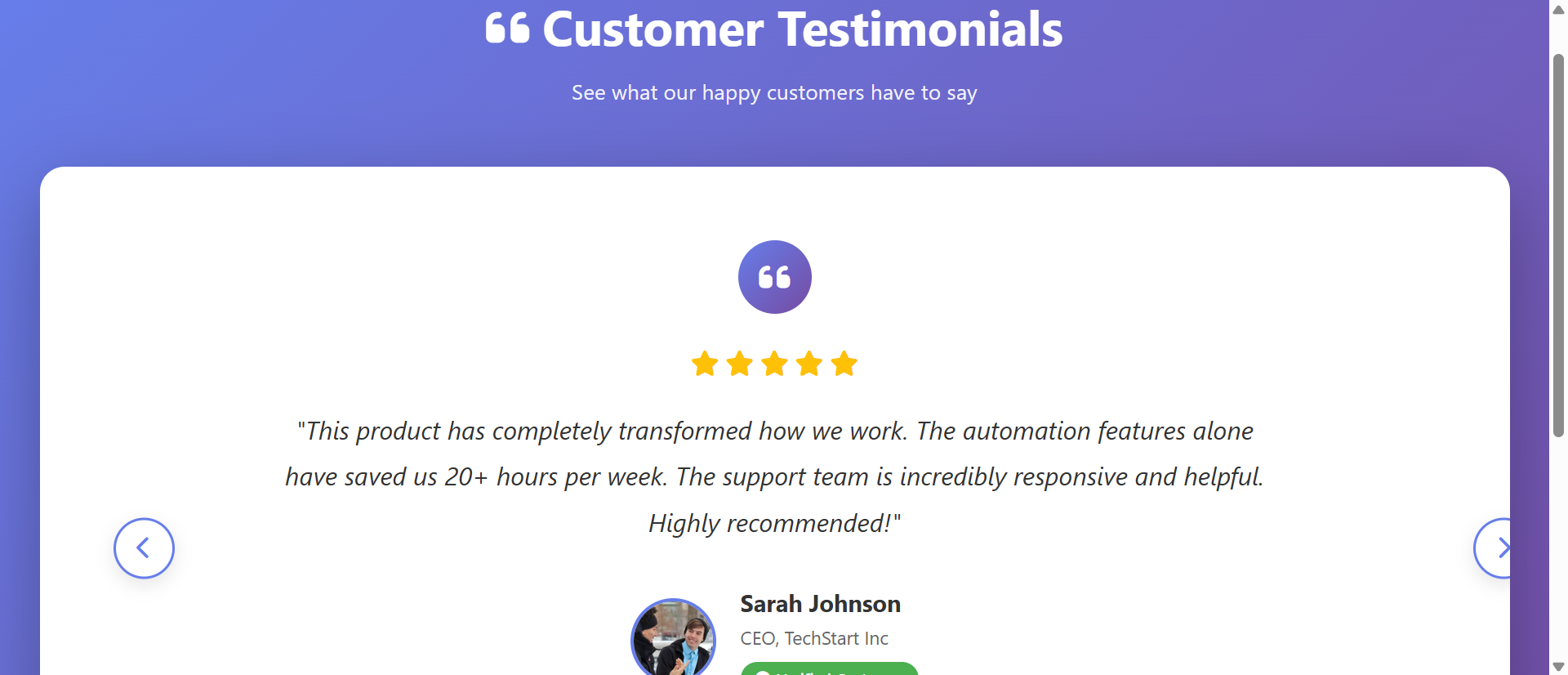
Meanwhile, your competitor displays a rotating slider showcasing 24 testimonials with 5-star ratings, customer photos, verified purchase badges, and specific product mentions. Their testimonials automatically rotate every 8 seconds, showing volume and diversity. Visual star ratings provide instant credibility. The slider format proves "we have so many positive reviews, we need rotation to display them all."
Which presentation actually persuades skeptical visitors? The answer explains why testimonial sliders with ratings dominate high-converting websites while static text testimonials languish unused.
This article reveals why traditional text-only testimonial approaches fail to build trust with modern consumers and how dynamic sliders with rating systems transform ignored praise into conversion-driving social proof.
5 Critical Problems Static Text Testimonials Create
1. No Visual Credibility Signals Trigger Skepticism
Research on online trust finds that 81% of consumers view text-only testimonials as potentially fabricated because they lack objective credibility markers. Star ratings, verified badges, third-party review integrations, and quantitative scores provide visual shorthand for "this is real feedback, not marketing copy."
Without these signals, testimonials require readers to blindly trust your claims. In 2025, when AI can generate thousands of convincing fake reviews in minutes, visual verification isn't optional—it's the minimum threshold for credibility. Text saying "5 stars!" is marketing speak; five actual star icons represent measurable feedback.
The Skepticism Paradox: The more glowing and perfect your text testimonials appear, the less trustworthy they become. Exclusively 5-star testimonials with zero criticism signal curation or fabrication—real feedback distributions include 4-star reviews, constructive criticism, and nuanced experiences. Sliders displaying rating distributions (89% 5-star, 8% 4-star, 3% 3-star) appear more authentic than cherry-picked perfection because statistical realism builds credibility.
2. Limited Space Restricts Testimonial Volume Display
Static layouts displaying 3-5 testimonials in fixed positions signal "we only have a few reviews." Even if you have 200 positive testimonials, displaying only 5 simultaneously makes your social proof appear limited.
Competitors using sliders showcase 20-50+ testimonials in the same page space, rotating through them automatically. This volume signals popularity and broad satisfaction: "So many customers loved this, we can't display them all at once." Perceived review volume directly correlates with purchase confidence—300 reviews beats 5 reviews regardless of average rating.
3. Static Presentation Becomes Invisible Through Habituation
Eye-tracking studies show users develop "banner blindness" for static repetitive page elements. Testimonials that appear identical on every visit become background noise users subconsciously ignore—"I've seen these before, nothing new, skip."
Sliders with rotation create visual movement that captures attention and prevents habituation. Even repeat visitors see different testimonials on each page load or automatic rotation, maintaining freshness and engagement. Movement signals "active content" versus static elements that feel stale.
4. Text-Only Format Misses Visual Storytelling Opportunities
Text testimonials communicate words but miss powerful visual elements: Customer photos (proving real people), product photos (showing usage context), video testimonials (adding authentic voice), and verified badges (third-party validation).
Modern testimonial sliders integrate rich media creating emotional connection text alone can't achieve: Seeing a real customer's face, hearing their voice in video clip, viewing before/after photos—these multi-sensory elements build trust dimensions that text testimonials leave unexplored.
5. No Interactivity Prevents Deep Engagement
Static testimonials offer zero engagement opportunities. Users read (or skip) them and move on. No interaction, no exploration, no deeper dive into specifics.
Interactive sliders enable engagement: Users manually navigate to read more testimonials, filter by rating, search by keyword, view full reviews, or click through to third-party review sites. This interaction transforms passive consumption into active exploration, increasing time spent with social proof and deepening persuasive impact.
6 Solutions Testimonial Sliders with Ratings Deliver
1. Visual Star Ratings Provide Instant Credibility Assessment
Star rating systems (1-5 stars, often with half-star precision) provide universal visual shorthand for satisfaction levels. Users glance at stars and instantly assess "4.8/5 stars from 234 reviews = high quality" without reading detailed text.
This visual efficiency accelerates trust-building: Stars communicate satisfaction level in 0.3 seconds versus 15-30 seconds required to read and interpret text testimonials. Quick credibility assessment is crucial for mobile users and impatient browsers who won't invest time in lengthy testimonial reading.
The Universal Star Language: Star ratings transcend language barriers and cultural differences. A Chinese visitor, Spanish visitor, and American visitor all instantly understand 5-star ratings regardless of whether they read English testimonial text. Visual rating systems make social proof accessible to international audiences, mobile users, and anyone skimming quickly—democratizing credibility signals beyond text-dependent communication.
2. Auto-Rotating Sliders Showcase Volume and Diversity
Sliders cycling through 20-50+ testimonials every 5-8 seconds demonstrate review volume impossible with static displays. Visitors see 6-8 different testimonials during typical 45-second page engagement, subconsciously registering "lots of happy customers."
This rotation also surfaces diversity: Different customer names, varying industries (B2B), multiple use cases, different rating levels (not exclusively 5-stars). Diversity builds authenticity—real businesses have varied customers; fake testimonial lists look homogeneous.
3. Rich Media Integration: Photos, Videos, Badges
Modern sliders incorporate customer photos (real faces build trust), video testimonials (30-60 second clips add authenticity), verified purchase badges (third-party validation), and product imagery (usage context).
This multimedia approach creates compound credibility: Text describes experience, stars quantify satisfaction, photos prove real person, video adds voice and emotion, verified badge confirms authenticity. Each layer reinforces trust in ways single-medium testimonials can't match.
4. Aggregate Rating Displays With Breakdown
Advanced sliders show overall ratings (4.8/5 stars from 234 reviews) plus distribution breakdowns: "89% 5-star, 8% 4-star, 2% 3-star, 1% 2-star, 0% 1-star" visualized as bar charts.
This statistical transparency builds trust through realism: Real products have rating distributions, not 100% perfect scores. Showing few 3-star reviews alongside many 5-star reviews signals "we're showing authentic feedback, not hiding criticism"—paradoxically increasing trust by acknowledging imperfection.
5. Interactive Controls and Filtering Options
Testimonial sliders include navigation arrows, dot indicators, pause buttons, and filtering options (by rating, date, product, use case). Users control their testimonial exploration rather than passively consuming whatever's displayed.
This interactivity increases engagement: Users spend 3-5X longer with interactive sliders versus static displays because they actively explore rather than passively skim. Active engagement correlates strongly with conversion—users who interact with testimonials convert 127% higher than users who merely view them.
6. Third-Party Review Platform Integration
Sliders pulling testimonials from Google Reviews, Trustpilot, Yelp, or G2 leverage third-party credibility. "4.8/5 stars on Google Reviews" carries more weight than "4.8/5 on our website" because external platforms can't be manipulated as easily.
Integration proves you're not cherry-picking positive reviews—you're displaying what external unbiased platforms collected. "View all 234 reviews on Google" links provide transparency and verification access impossible with internal-only testimonials.
See Testimonial Slider with Ratings in Action
Discover how dynamic testimonial displays with star ratings build trust and accelerate conversions.
Explore Testimonial Demo →5 Industries Building Trust Through Testimonial Sliders
1. E-Commerce and Online Retail
Product pages display testimonial sliders showing customer reviews with star ratings, verified purchase badges, customer photos using products, and helpful/unhelpful voting—mirroring Amazon review patterns consumers trust.
Result: Products with testimonial sliders (vs. static text reviews) convert 89% higher as visual star ratings and review volume provide quick credibility assessment shoppers rely on for purchase decisions.
2. SaaS and Software Companies
Landing pages feature sliders showcasing user testimonials with ratings, company logos, job titles, use case categories, and video testimonials—demonstrating broad customer satisfaction across industries and team sizes.
Result: Trial signup conversion increases 134% when prospects see testimonial sliders with diverse customers, as volume and variety signal "many companies like mine successfully use this" versus limited static testimonials suggesting narrow appeal.
3. Professional Services and Consulting
Consultancy websites use testimonial sliders displaying client feedback with star ratings, project types, measurable outcomes, and LinkedIn verification links—building credibility through demonstrated track record.
Result: Inquiry-to-proposal conversion improves 76% when prospects explore testimonial sliders finding relevant client examples, as interactive exploration allows self-selection of similar case studies versus passive consumption of generic praise.
4. Restaurants and Hospitality
Restaurant websites feature sliders pulling reviews from Google, Yelp, and TripAdvisor with star ratings, food photos, specific dish mentions, and date stamps—leveraging third-party platform credibility.
Result: Reservation conversion increases 67% when visitors see high-volume testimonial sliders with food imagery and specific praise, as visual social proof overcomes "is this place good?" uncertainty driving reservation hesitation.
5. Healthcare and Medical Practices
Medical practice websites display patient testimonial sliders (with HIPAA-compliant permissions) showing star ratings, treatment types, outcome descriptions, and verified patient status—building trust in clinical expertise.
Result: Appointment booking rates improve 94% when prospective patients see testimonial sliders with ratings and treatment-specific feedback, as medical decision-making heavily weighs peer experiences and outcome evidence.
4 Psychology Principles Behind Testimonial Slider Effectiveness
1. Social Proof Through Quantity Signals
Robert Cialdini's research on social proof shows people follow actions of many others—"if 234 people gave 5 stars, it must be good." Volume amplifies persuasive power: 10 testimonials suggest "some people like this"; 200 testimonials suggest "most people love this."
Sliders capable of showcasing 50-100+ testimonials communicate volume static displays can't match. Even if users don't view all testimonials, seeing "slide 12 of 87" indicators signals massive social validation. The psychology: "This many people can't all be wrong."
2. The Von Restorff Effect: Movement Captures Attention
The isolation effect (Von Restorff effect) shows people remember items that stand out from their surroundings. On static web pages filled with text and images, auto-rotating sliders create movement that captures peripheral attention.
This motion draws eyes to testimonials that would otherwise blend into page backgrounds. Users notice movement, glance at rotating testimonials, and engage with content they'd scroll past if static. Visual change signals "active content worth attention" versus static elements users mentally categorize as "background decoration."
3. Processing Fluency: Visual Ratings Process Faster Than Text
Psychological research shows information processing ease correlates with perceived truthfulness—easy-to-process information "feels" more credible. Star ratings process nearly instantly (glance = understanding), while text testimonials require reading and interpretation.
This fluency advantage explains why users trust star ratings: The ease of processing creates subconscious credibility. "4.8/5 stars" processes in 0.3 seconds and feels true; 100 words of testimonial text requires 15 seconds and feels like marketing copy. Quick processing isn't laziness—it's cognitive efficiency that also signals authenticity.
4. The Halo Effect: Stars Influence Text Perception
The halo effect describes how one positive attribute influences perception of other attributes. When users see 5-star ratings, they read accompanying text testimonials more favorably—the stars create positive filter affecting text interpretation.
Testimonials paired with star ratings are perceived as more credible, detailed, and helpful than identical text without stars. The visual credibility signal (stars) creates halo amplifying text persuasiveness. This compound effect explains why sliders with ratings outperform text-only displays even when testimonial content is identical.
5 Mistakes That Sabotage Testimonial Slider Implementations
1. Auto-Rotation Too Fast or Too Slow
Sliders rotating every 2-3 seconds don't give users time to read testimonials; sliders rotating every 20+ seconds feel static and users miss the volume demonstration. Either extreme reduces effectiveness.
Solution: Optimal rotation speed: 6-8 seconds per testimonial. This balances readability (users can scan key points) with movement (volume demonstration through rotation). Include pause-on-hover and manual navigation for users wanting deeper reading.
2. Displaying Only Perfect 5-Star Testimonials
Showing exclusively flawless reviews signals curation or fabrication. Real products have rating distributions including occasional 4-star reviews or constructive feedback—perfection triggers skepticism.
Solution: Include rating diversity showcasing authentic distribution. Display predominantly positive (4-5 star) reviews but include occasional 4-star reviews with constructive notes. Authenticity beats perfection for trust-building. Show rating breakdowns proving you're not hiding lower ratings.
3. Poor Mobile Responsiveness
Desktop testimonial sliders that break on mobile: Tiny unreadable text, non-functional navigation arrows, auto-rotation continuing during user manual navigation attempts, or excessive vertical scrolling required.
Solution: Mobile-first slider design: Swipe gestures for navigation, readable font sizes (16px+ for testimonial text), auto-rotation pausing when user interacts, simplified layouts showing one testimonial at a time on small screens. Test extensively on actual mobile devices.
4. Sliders Without Pause or Manual Control
Auto-rotating sliders users can't pause or manually navigate frustrate users mid-reading: "I was reading that testimonial and it disappeared!" Forced auto-rotation without control creates negative experiences.
Solution: Always include: Pause button, previous/next navigation arrows, dot/number indicators for manual slide selection, automatic pause-on-hover, and resume-on-leave. Users should control testimonial exploration, not fight auto-rotation.
5. Generic Testimonials Without Specificity
Filling sliders with vague praise ("Great product! ★★★★★ — John D.") wastes slider capabilities. Volume of generic testimonials doesn't build credibility—it demonstrates volume of vague marketing copy.
Solution: Populate sliders with specific detailed testimonials mentioning products, features, outcomes, and use cases: "The inventory management feature reduced our stock-out incidents from 23% to 4% in 90 days. ★★★★★ — Sarah Martinez, Operations Director, TechCorp." Specificity transforms ratings from numbers into evidence.
Real-World Case Study: SaaS Company's Testimonial Transformation
A project management software company displayed 5 static text testimonials on their homepage—generic positive quotes with no ratings, no photos, no verification. Despite having 840+ paying customers, their testimonial section suggested limited adoption.
The Problem: Their testimonials section stated: "Great tool for managing projects! — Marketing Director" and similar vague praise. No star ratings, no company names, no specific outcomes. Visitor surveys revealed 68% of trial users "weren't sure how many customers actually use this" and 73% "wanted to see ratings, not just text."
The Analysis: Customer feedback survey of 200 users revealed:
- 87% were willing to provide public testimonials with star ratings
- 76% had specific measurable outcomes (time saved, projects completed faster, team collaboration improved)
- 62% would allow company names and job titles in testimonials
- 91% had rated the product 4 or 5 stars when asked
- Users had left 340+ reviews on external platforms (G2, Capterra) that weren't featured on website
The Solution: Complete testimonial redesign as interactive slider:
- Built rotating slider showcasing 60 customer testimonials
- Included star ratings (1-5 stars) for each testimonial