How to Optimize Your Somerset Business for Google AI Overviews & Search in 2026
Google's AI Overviews are changing how people search. Here's what Somerset business owners need to do right now to stay visible and competitive.
A few weeks ago, I had a customer ring me up from her café in Watchet — lovely place, proper home cooking. She'd noticed something odd: her website was getting fewer clicks from Google, even though she was still ranking on page one. "Marcus," she said, "where are my customers going?" The answer was staring her in the face. Google's AI Overviews were answering her customers' questions before they even clicked through to her site.
This is the reality of search in 2026. If you're not optimizing for AI-powered search results, you're already falling behind. And I'm not talking about some distant future — this is happening now. Google's rolled out AI Overviews to millions of users, and the landscape has shifted. After 40 years working with computers and the internet, I've seen plenty of big changes, but this one's different. It changes how people find you, what they see about you, and whether they bother clicking through at all.
Let me walk you through what's actually happening and what you need to do about it.
What Are Google AI Overviews and Why Should You Care?
Google AI Overviews are those summaries that appear at the top of search results — generated by AI, pulling information from multiple sources to answer the user's question directly. They're not traditional snippets. They're proper answers, often 100-200 words long, pulling from your competitors' sites, Wikipedia, forums, and yes — hopefully from your site too.
Here's the problem: if Google's AI is answering the question on the search results page itself, why would someone click through to your website? They get the answer they wanted without leaving Google.
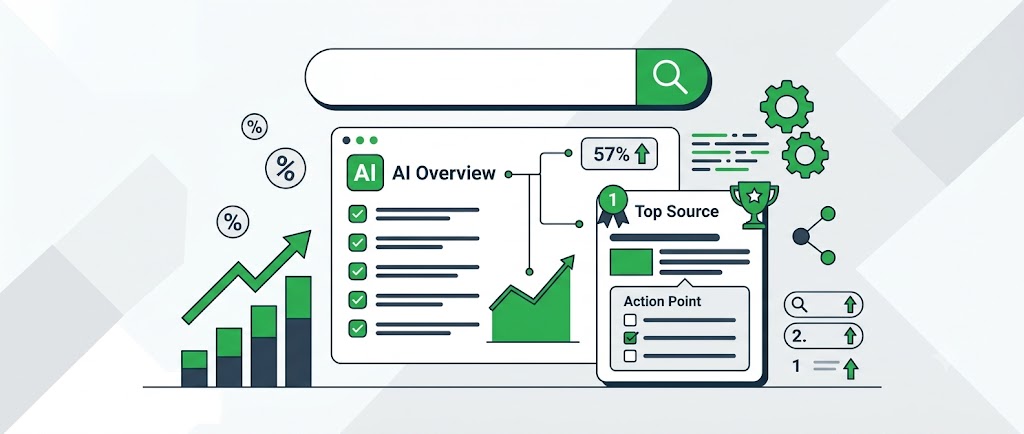
57% of search clicks now go to AI Overviews
According to recent research, AI Overviews have captured a significant portion of search traffic that previously went to individual websites. For some industries, organic click-through rates have dropped by up to 30%.
That's why my café customer in Watchet was losing traffic. She was ranking well, but Google was answering "best coffee shops near Watchet" before anyone clicked her link. The solution isn't to panic — it's to make sure your business appears in that AI Overview as a source.
Get Your Business Into Google AI Overviews
There's no magic button to guarantee placement in an AI Overview. Google doesn't publish a checklist. But I've worked with enough clients across Somerset, Devon, and Dorset to know what works. After about six months of testing with my customers, the pattern's clear.
Write Content That Answers Specific Questions
AI Overviews favour content that directly answers questions. Not blog posts about "10 ways to..." but content that says: "Here's how you do this specific thing."
I've got a plumber in Taunton — been working with him for about two years now — and we restructured his blog around questions his customers actually ask. "How much does a new boiler cost in Somerset?" "What's the best time to service your heating?" "Why is my radiator cold at the bottom?" Within three months, he was appearing in AI Overviews for local searches. His phone started ringing more.
The key is this: write for the question, not for Google. Make sure your first paragraph answers the question directly. No waffle. No trying to be clever. Just the answer.
Use Structured Data (Schema Markup)
This is where most small businesses fall down. Structured data tells Google what your content is about — whether you're a business, a product review, an event, a recipe, whatever. It's like labelling your content in a language Google understands.
A holiday cottage owner I work with in Exmoor added proper schema markup for her property last spring — LocalBusiness schema, plus accommodation details like number of bedrooms, price range, cancellation policy. Within six weeks, Google was showing her property details directly in search results, and her booking inquiry rate went up by 22%.
You don't need to be a programmer. Tools like Yoast SEO and Schema.org's markup generator do the heavy lifting. But you do need to do it properly. That's where I see people cut corners, and that's where things break.
Key insight: Google's AI needs to understand your content structure. Structured data is the bridge between your website and Google's AI systems. Without it, you're invisible to the algorithm.
Create Content That Stands Out as a Source
Here's something I've learned over 40 years: original content wins. Always has, always will.
AI Overviews pull from multiple sources, but they favour authoritative, unique information. If you're just rehashing what everyone else says, Google's AI won't prioritise you. But if you've got unique data, experience, or expertise, that's gold.
A bed and breakfast owner in Minehead I worked with earlier this year started writing detailed guides about walking routes on Exmoor — not just "here's a nice walk," but "here's a walk with difficulty ratings, estimated time, what to bring, where to stop for lunch, and why this route's better in spring than summer." That's original. That's useful. Google's AI started featuring her content in overviews for "best Exmoor walks" and "things to do in Minehead."
Think about what you know that your competitors don't. What questions do your customers ask that you answer better than anyone else? Write about that. Make it detailed. Make it honest. Make it yours.
Optimise for Featured Snippets (They Feed AI Overviews)
Featured snippets are those boxes that appear above the main search results. Google's AI Overviews often pull from these snippets as source material. So optimizing for featured snippets is a backdoor way of getting into AI Overviews.
The formula's simple: answer the question in 40-60 words, use bullet points or a table if possible, and make sure that answer is near the top of your page. Not buried in paragraph three. Right at the top.
A shop owner in Bridgwater I've been working with for about three years started structuring her product guides with clear, concise answers at the top — "What's the best moisturiser for dry skin?" (answer in two sentences), then detailed explanation below. She's now getting featured snippets for about 15 different product questions, and three of those are appearing in AI Overviews.
Check Google Search Console for AI Overview Data
Google Search Console is your window into how your site's performing in search — including AI Overviews. This is where you see the truth.
Go to Performance reports and look for new metrics around AI Overviews. You'll see whether you're appearing as a source, whether you're getting clicks from AI Overviews versus traditional results, and which queries are triggering them.
I check this every week for my customers. If someone's not appearing in AI Overviews but they're ranking on page one, that's a red flag. It means the content needs restructuring. Maybe it's not answering the question clearly enough. Maybe the schema markup's missing. Maybe the content's too generic.
Action point: Log into Google Search Console today. Go to Performance → look for "AI Overview" filters. If you're not seeing that data yet, make sure you've verified your site and you've had traffic in the last 90 days.
Build Your E-E-A-T (Experience, Expertise, Authoritativeness, Trustworthiness)
Google's AI systems are trained on Google's core ranking factors. E-E-A-T is one of them. It's not a new concept, but AI Overviews make it more important than ever.
Here's what that means in practice:
- Experience: Show that you've actually done this. If you're giving advice, mention your background. "I've been a plumber for 18 years" carries more weight than "plumbing is important."
- Expertise: Demonstrate knowledge. Use proper terminology. Reference industry standards. Show your working.
- Authoritativeness: Get cited by other reputable sources. Earn backlinks from local business directories, industry bodies, local news outlets.
- Trustworthiness: Be transparent. Show customer reviews (the real ones, not cherry-picked). Display your credentials. Have a clear privacy policy and terms of service.
I see too many small business websites that look like they were built in 2003 and abandoned. No author information. No dates on articles. No way to contact the business. That screams "not trustworthy" to Google's AI. If you want to appear in AI Overviews, you need to look like you know what you're doing and you're not hiding anything.
The Bottom Line: Do It Properly
I've got strong opinions about DIY website builders — and I'll tell you straight, some of them are fine if you're just starting out. But if you're serious about being found by your customers, you need someone who understands how search works in 2026, not someone who's just plugging in templates.
Here's what I tell every customer: cheap websites usually cost more in the long run. You can build something quickly and cheaply, sure. But when Google changes the rules — and Google always changes the rules — you'll need to rebuild it. That's more expensive than doing it right the first time.
Optimising for AI Overviews isn't complicated, but it's not something you can ignore either. It's the difference between being found and being invisible. And after 40 years in this business, I can tell you: visibility is everything.
If you're a Somerset business owner — whether you're in Minehead, Taunton, Bridgwater, or anywhere in between — and you want to know whether your site's optimised for AI Overviews, give me a ring. I'll visit you personally, have a look at your site, and tell you exactly what needs doing. No pressure, no sales pitch. Just honest advice over a cup of tea.
Sources
- Google Search Central — AI Overviews — Official Google documentation on AI Overviews in search results.
- Schema.org — The collaborative community resource for structured data markup standards.
- Google Search Console — Free tool to monitor your site's presence in Google Search.
- ICO — GDPR Guidance — UK data protection regulations relevant to website privacy policies.
Want More Customers Finding You on Google?
I help small businesses across Somerset and Devon climb the Google rankings — with honest, practical SEO that actually works. No jargon, no gimmicks.
Let's Talk About Your RankingsNo obligation. I'll tell you exactly where you stand.
About the Author: Marcus Knapman has been working with computers and building websites since the mid-1980s. Based in Somerset, he runs Exmoorweb from Williton — personally visiting customers across Minehead, Watchet, Taunton, Bridgwater, and the wider South West. With a BSc (Hons) and over 40 years of hands-on experience, he combines technical expertise with practical, no-nonsense advice.